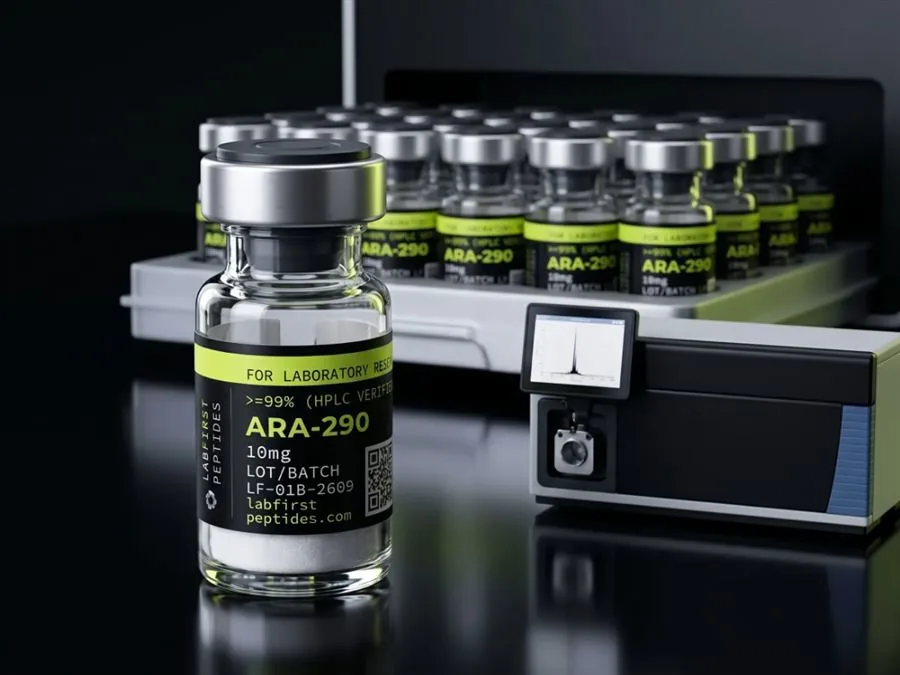
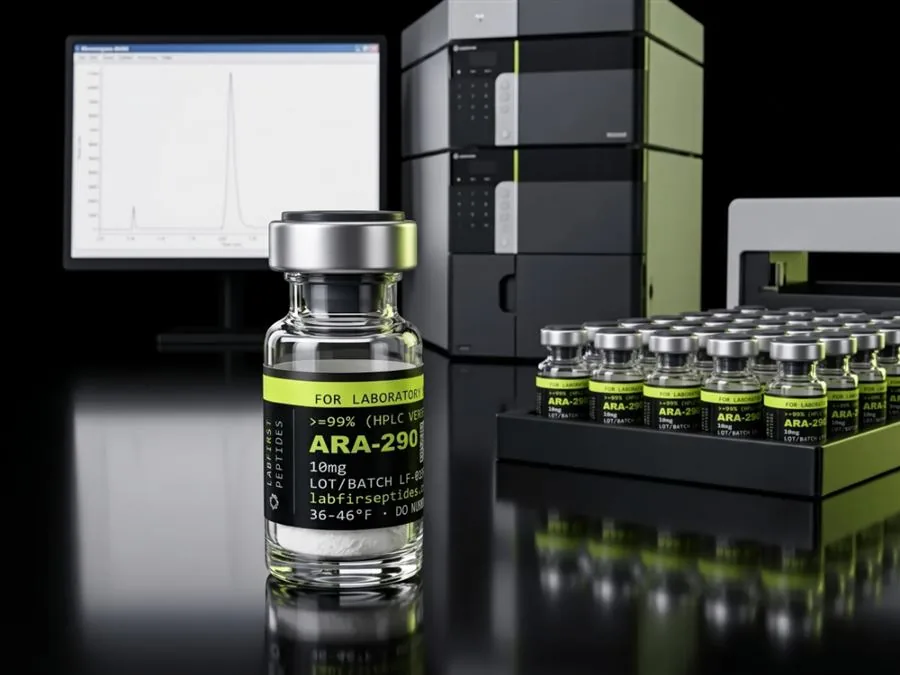
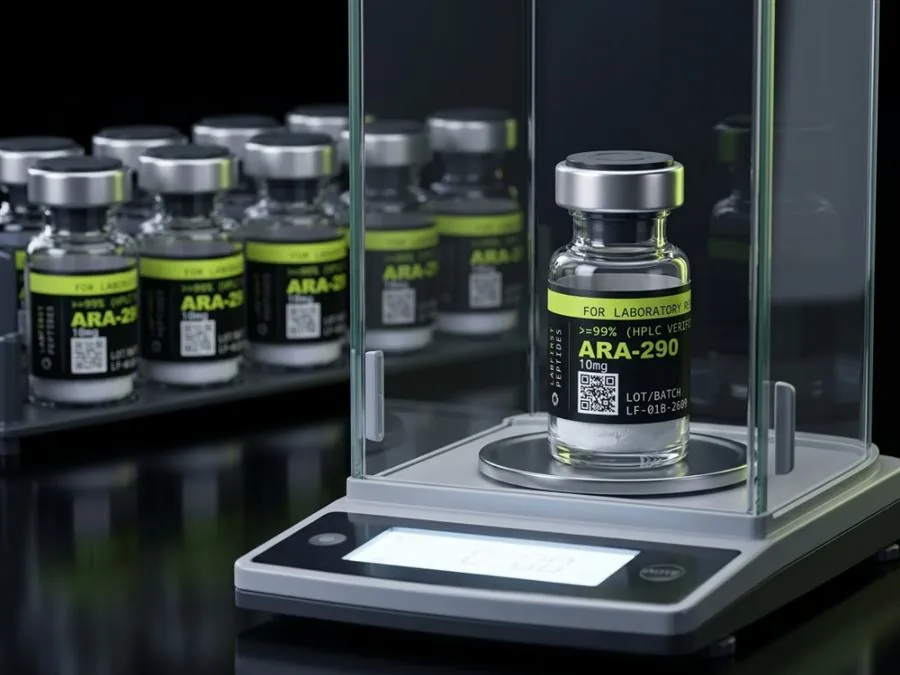
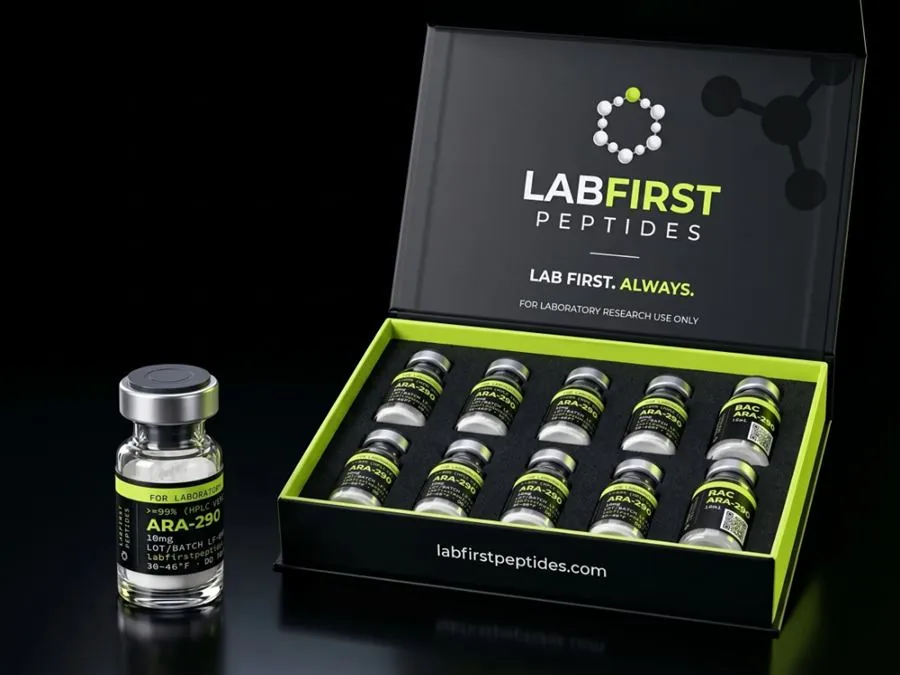
Shop / ARA-290 research peptide
Buy ARA-290 Peptide
An 11-residue peptide, pyroglutamate helix B surface peptide (pHBSP), also called cibinetide — modeled on the three-dimensional structure of erythropoietin in the region of helix B, supplied freeze-dried in a sealed vial and tested lot by lot at Kovera Labs.
C51H84N16O21 · 1,257.3 g/mol
ARA-290 Peptide price by sizeBackordered
$70.00$7.00 per mgSave 0% per mg
Join the waitlist for
We are restocking this size and expect it in stock within 5 to 7 days. Everyone on the waitlist hears first.
You are on the list. Check your inbox.
FOR LABORATORY AND IN-VITRO RESEARCH USE ONLY. NOT FOR HUMAN OR ANIMAL CONSUMPTION.
Backordered: join the waitlist and we email you the moment it lands
Free shipping on orders over $150.00
Lab certificate · 10mg
This size's lot is in testing. Its results appear here as soon as the lab report is in.
In short: ARA-290 is an 11-residue peptide, pyroglutamate helix B surface peptide (pHBSP), also called cibinetide — modeled on the three-dimensional structure of erythropoietin in the region of helix B (formula C51H84N16O21, average mass 1,257.3 g/mol, CAS 1208243-50-8). ARA-290 is sold here for laboratory research in 1 size (10mg), from $70.00 a vial. It is not an FDA-approved medicine. Research use only, and never for people or animals.
Often bought with
ARA-290 specifications
| Product name | ARA-290 |
|---|---|
| Also sold as | ARA 290 peptide, cibinetide |
| Formula | C51H84N16O21 |
| Average mass | 1,257.3 g/mol |
| CAS number | 1208243-50-8 |
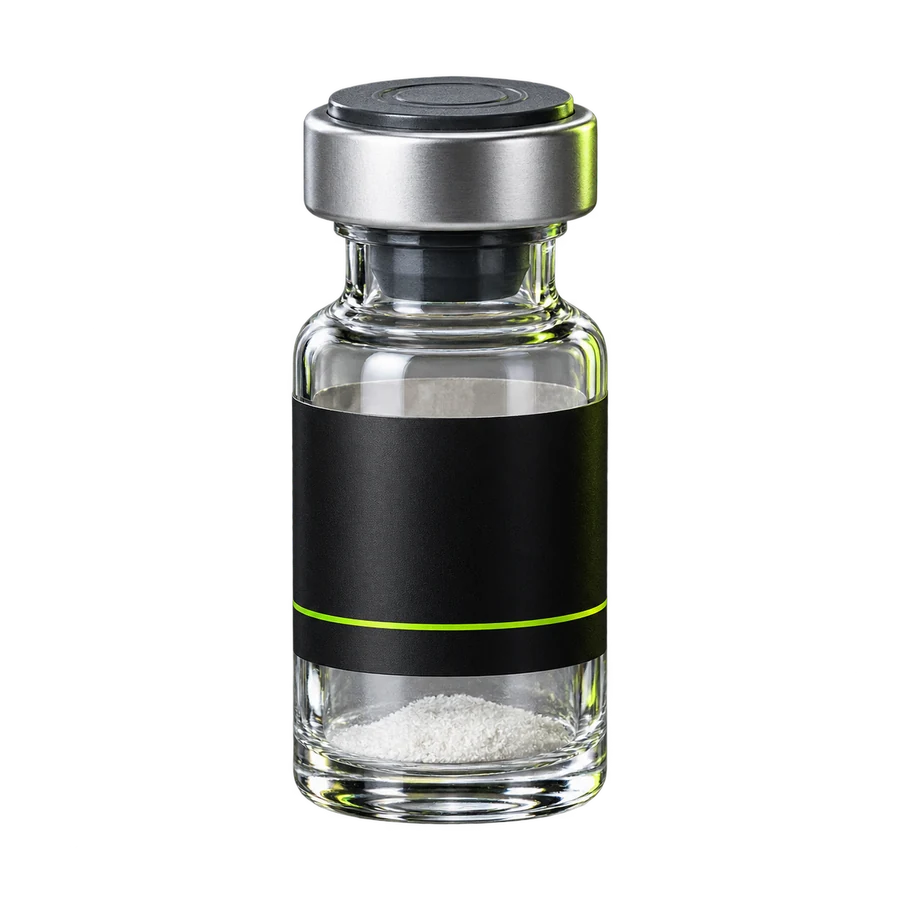
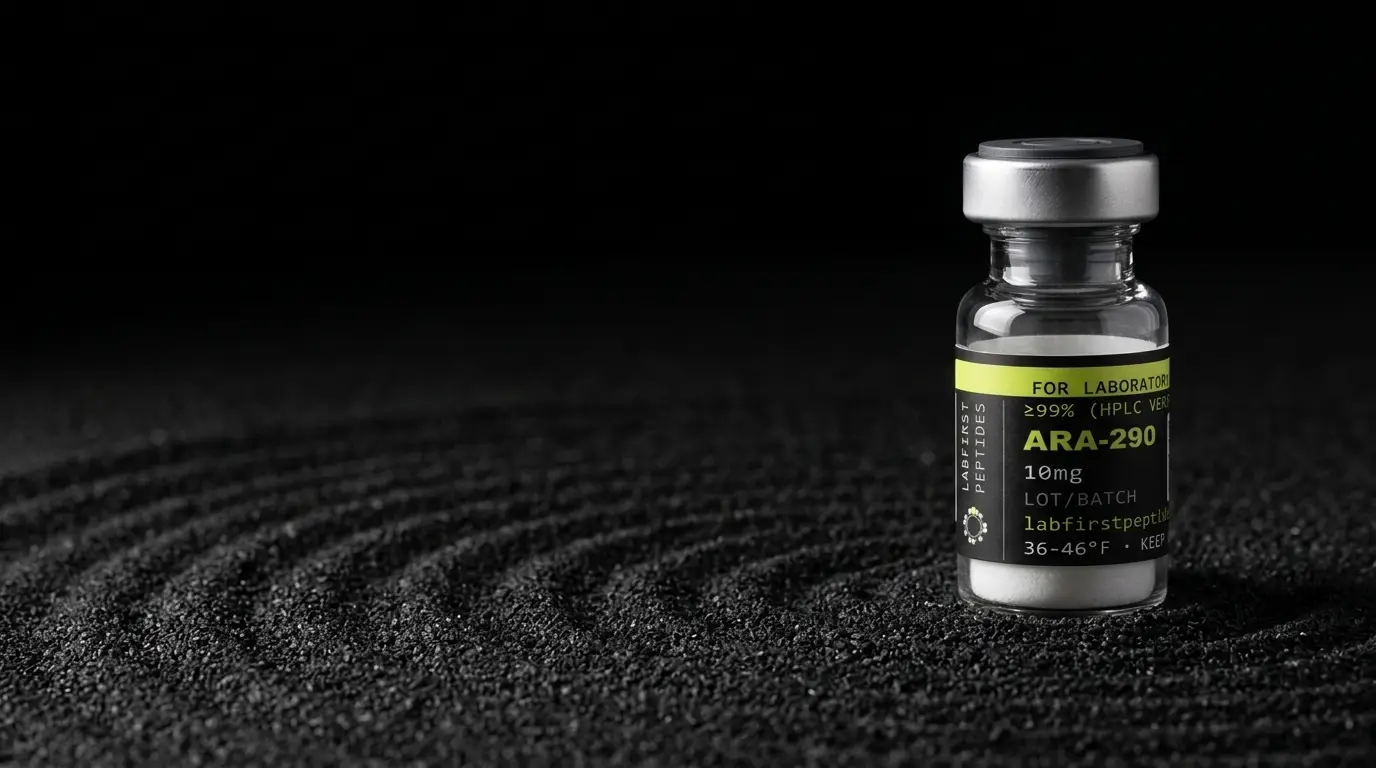
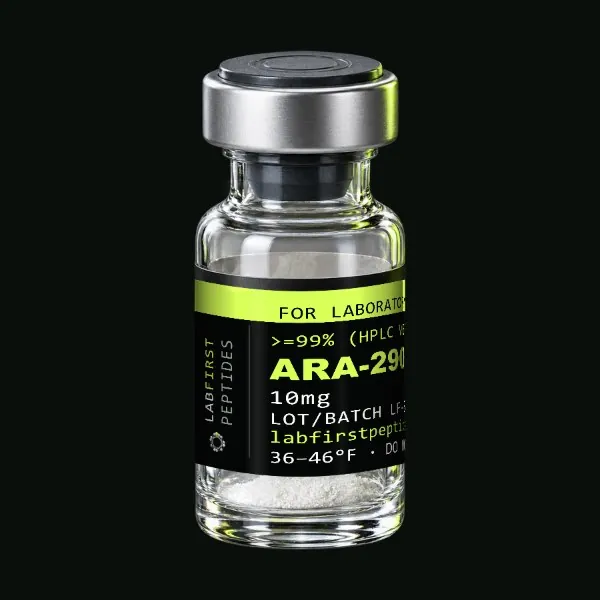
| Physical form | Freeze-dried powder, a solid cake in a sealed vial |
| Appearance | White to off-white cake |
| Sizes on this page | 10mg |
| Purity specification | ≥99% by RP-HPLC. The number for the lot you receive is whatever its own certificate says. |
| Identity check | Mass spectrometry, read against the mass this compound should have |
| Net content | Weighed per lot and reported separately from purity |
| Lot documentation | Tested by Kovera Labs; each lot's certificate posts here when it is reported |
| Storage | Sealed, cold and out of the light |
| Ships from | Santa Ana, California by USPS with tracking on every order, same business day on verified in-stock orders placed before 12 PM Pacific |
| Intended use | Laboratory research only. Not for human or animal use. |
What is ARA-290, and what is it used for?
ARA-290 is also listed and searched as ARA 290 peptide, cibinetide. They all mean the same compound. Supplier lists write it as ARA-290 peptides or peptide ARA-290 as well; every one of those is this record. A name is not a test, which is why the lot record further down counts for more than the wording on a label.
Chemically: molecular formula C51H84N16O21, average mass 1257.3 g/mol (PubChem CID 91810664). Those figures are what the identity test on a certificate is read against.
Class
An 11-residue peptide, pyroglutamate helix B surface peptide (pHBSP), also called cibinetide — modeled on the three-dimensional structure of erythropoietin in the region of helix B.
Mechanism
A selective ligand of the innate repair receptor, a heterodimer of the erythropoietin receptor with the beta common receptor subunit. It deliberately does NOT activate the EPO receptor homodimer that drives red cell production, which is the entire point of its design.
Where it appears in the literature
Tissue protection and repair in experimental animal models of disease and in clinical trials, developed by Araim Pharmaceuticals.
What is not established
No approved product. Plasma half-life is around two minutes, and the mechanism by which such a short-lived peptide produces sustained effects is not fully explained.
ARA-290 for sale: 10mg vials, price per mg
ARA-290 is sold in 1 size here, 10mg, from $70.00 a vial. ARA-290 cost and ARA-290 price per mg by size are in the table, at each volume tier and on subscription; the per-mg figure under each price is the one that compares across sizes.
Volume and subscription pricing by size
| Size | One vial | 10–19 vials−10% | 20 vials−15% | Subscribe monthly−6% from shipment 2 | Availability |
|---|---|---|---|---|---|
| ARA-290 10mg | $70.00$7.00/mg | $63.00a vial · $6.30/mg | $59.50a vial · $5.95/mg | $65.80a vial, shipment 2 on · $6.58/mg | Backordered — waitlist |
Volume tiers are per size and do not combine across sizes (see bulk pricing). Subscribe & Save takes 6% every month, 4% every 2 months or 2% every 3 months off from shipment 2, two shipments minimum, and stacks on the volume tier: the lowest this record ever bills is $5.59 per mg, twenty 10mg vials on a monthly subscription from shipment 2 onward.
Nothing is added at checkout except the USPS shipping you choose; dispatch and delivery are the same on every order. The cost-per-milligram tool ranks the whole catalog by price per mg.
Where to buy ARA-290: what to check before you order from anyone
ARA-290 for sale, or ARA-290 peptide for sale, means this page: one record, 1 size. You can buy ARA-290 online here with guest checkout; verified in-stock orders placed before 12 PM Pacific are dispatched the same day.
Before ordering ARA-290 from anyone, us included, run the 5 checks on verifying a certificate; the first is that the report resolves on the laboratory's own site, and a seller who cannot pass them is asking for the trust a certificate exists to replace.
ARA-290 vs BPC 157: different molecules, separate records
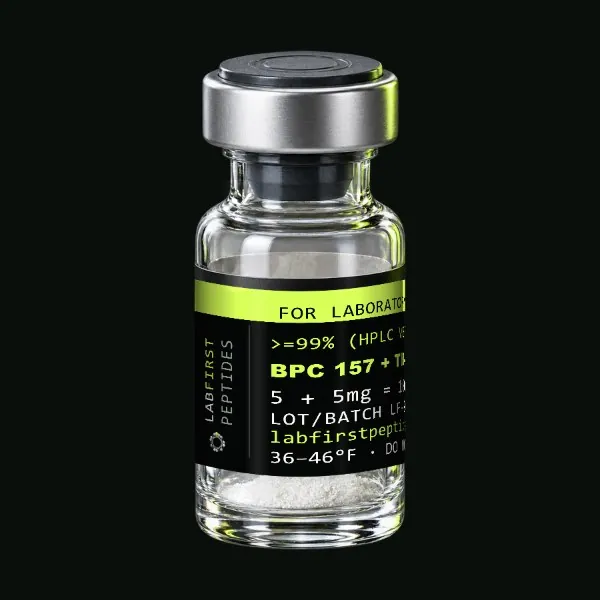
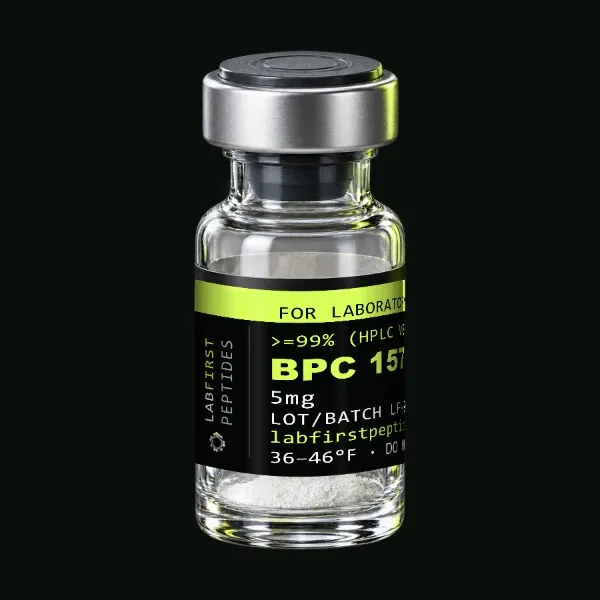
ARA-290 vs BPC 157, or BPC 157 vs ARA-290, is the comparison people search most, and they are not the same thing. Each is a different molecule with a different formula, mass and research record, and each has its own certificate here.
BPC 157 vs ARA-290: the same comparison, side by side
| Record | Class | Formula | Avg. mass | Sizes here |
|---|---|---|---|---|
| ARA-290 | An 11-residue peptide, pyroglutamate helix B surface peptide (pHBSP), also called cibinetide — modeled on the three-dimensional structure of erythropoietin in the region of helix B. | C51H84N16O21 | 1257.3 | 10mg from $70.00 |
| BPC 157 | A man-made fifteen-amino-acid peptide, based on a protein found in stomach juice. | C62H98N16O22 | 1419.5 | 5mg · 10mg from $49.00 |
Documentation compared in full: ARA-290 vs BPC 157, side by side.
The ARA-290 certificate: lot, purity, identity, and how to verify it
A certificate answers identity, purity and net content as three separate questions, each with the method that produced it and the date it was run, how to read one covers what each field does and does not cover. For ARA-290 that means a mass spectrum landing on 1,257.3 g/mol for C51H84N16O21, the figure published against PubChem CID 91810664.
Listings elsewhere describe ARA-290 as an acetate, an arginate salt or an N-acetyl form. Those are different chemical forms with different masses, and a certificate identifies which one was actually tested. The form of the lot on this page is whatever its certificate states; it is not assumed from a listing name, ours included.
ARA-290 certificates post here and in the certificate index when Kovera Labs reports on the lot.
Solution arithmetic for the bench, with no administration guidance: the vial concentration calculator, preset to ARA-290.
Where the FDA stands on ARA-290
FDA status, and what this listing is Not an FDA-approved drug product
The FDA has not approved this compound for anything, and nothing in this catalog is a medicine.
Status verified 2026-08-25. Check the primary source before relying on this summary.
It is sold as laboratory material under the research-use restriction below. Being listed is not an approval, and not a claim that it is safe, effective or right for any purpose.
ARA-290 research: what the published studies examine
Status: No FDA-approved application. This compound is sold as laboratory material. Where research on it has been published, it sits at the animal, cell or early-human stage, and this record does not summarize what it found. A supplier is not a neutral judge of evidence about its own catalog.
ARA-290 is the product of an unusually clean piece of receptor reasoning. Erythropoietin has two distinct activities mediated by two distinct receptors: it stimulates red cell progenitors through an EPO receptor homodimer, and it triggers tissue protection and repair through a separate heterodimer of the EPO receptor with the beta common receptor subunit, termed the innate repair receptor. Recombinant EPO cannot be used for tissue protection because activating the first receptor raises haematocrit, activates platelets and increases thrombosis risk.
So the field engineered ligands that hit the second receptor and not the first. ARA-290 is the latest of these — an 11-residue peptide modeled on EPO's helix B surface. One further feature is worth knowing because it is genuinely unusual: the innate repair receptor is typically NOT expressed by normal tissue, and is rapidly induced by injury or inflammation, so the target only appears where there is damage.
| Reported observation | Model | Source |
|---|---|---|
| The erythropoietic and tissue-protective effects of EPO are mediated by different receptors — an EPOR homodimer for red cell progenitors, and an EPOR/beta-common-receptor heterodimer termed the innate repair receptor for tissue protection, which is typically not expressed in normal tissue but is rapidly induced by injury or inflammation. ARA-290 (pHBSP) selectively activates the IRR without interacting with the EPOR homodimer. Despite a plasma half-life of approximately 2 minutes, it activates a molecular switch producing sustained biological effects observed in animal disease models and clinical trials. | review of pharmacokinetic and pharmacodynamic data across animal models and clinical trials | Collino, Thiemermann, Cerami and Brines, Flipping the molecular switch for innate protection and repair of tissues: long-lasting effects of a non-erythropoietic small peptide engineered from erythropoietin, Pharmacology and Therapeutics (2015)Two authors are at Araim Pharmaceuticals, which develops the compound; two are at academic institutions. |
Open questions. The receptor rationale is elegant and the selectivity claim — activating the repair receptor without the erythropoietic one — is the compound's whole reason for existing and appears well supported. The open question is the one the authors themselves foreground: a peptide with a two-minute plasma half-life producing effects lasting far longer is not explained by ordinary pharmacokinetics, and the proposed "molecular switch" is a description of the puzzle rather than a solution to it.
Until that is resolved, the relationship between exposure and effect is genuinely unclear, which makes results hard to reason about. No approved product exists, the review's framing is partly by the developing company, and the target receptor's induction-by-injury behavior means effects in healthy tissue should not be assumed to resemble effects in damaged tissue.
Each row above describes an observation in the stated model. None of it describes what ARA-290 would do in a person or an animal outside that model, and none of it is a recommendation to use it for anything.
How to store ARA-290: refrigeration and shelf life
Keep the sealed vial cold and out of the light and it stays as it left the lab. Once it is mixed into a solution, how long it holds up depends on the compound, what it was mixed with, how strong the solution is and how cold it is kept — too many variables for anyone to print one shelf life on a label. So laboratories write the date on whatever they prepare and keep their own record of it.
For solution preparation arithmetic on the bench, concentration, per-graduation values and molarity, use the vial concentration calculator, which opens with the ARA-290 sizes stocked here already loaded. It covers laboratory measurement only and contains no administration guidance.
Questions about ARA-290
Where to buy ARA-290 Peptide, and can I get it online?
Here, in 1 size, with guest checkout and shipping across the United States. All sizes are on the waitlist at the moment, and are being restocked, expected within 5 to 7 days. Each size carries its own lot record and certificate, verifiable at the issuing laboratory before you order.
How much does ARA-290 Peptide cost?
$70.00 for the 10mg vial, and the table above shows cost per mg for each, which is the comparison that transfers between sizes.
What is ARA-290 used for?
In the published research, Tissue protection and repair in experimental animal models of disease and in clinical trials, developed by Araim Pharmaceuticals. No approved product. Plasma half-life is around two minutes, and the mechanism by which such a short-lived peptide produces sustained effects is not fully explained. This record sells it for laboratory work and says nothing about use in a person or an animal.
What is the difference between ARA-290 and BPC 157?
ARA-290 and BPC 157 are different molecules. ARA-290: An 11-residue peptide, pyroglutamate helix B surface peptide (pHBSP), also called cibinetide — modeled on the three-dimensional structure of erythropoietin in the region of helix B. BPC 157: A man-made fifteen-amino-acid peptide, based on a protein found in stomach juice. Each has its own formula and its own certificate; a lot report for one says nothing about the other.
How does ARA-290 work, and what does it do?
At the level the published literature describes it, a selective ligand of the innate repair receptor, a heterodimer of the erythropoietin receptor with the beta common receptor subunit. No approved product. Plasma half-life is around two minutes, and the mechanism by which such a short-lived peptide produces sustained effects is not fully explained. This record sells it for laboratory work and says nothing about use in a person or an animal.
What does ARA-290 peptide do?
At the level the published literature describes it, a selective ligand of the innate repair receptor, a heterodimer of the erythropoietin receptor with the beta common receptor subunit. No approved product. Plasma half-life is around two minutes, and the mechanism by which such a short-lived peptide produces sustained effects is not fully explained. This record sells it for laboratory work and says nothing about use in a person or an animal.
What is ARA-290 peptide?
ARA-290 is an 11-residue peptide, pyroglutamate helix B surface peptide (pHBSP), also called cibinetide — modeled on the three-dimensional structure of erythropoietin in the region of helix B. Chemically: molecular formula C51H84N16O21, average mass 1257.3 g/mol (PubChem CID 91810664). It is sold here in a sealed vial with a certificate for the lot, for laboratory work only.
How do I verify a ARA-290 certificate of analysis is real?
Check it at the issuing laboratory, not with us: a real report carries a verification key or QR that resolves on the lab's own site, and one with no key is worthless. Reading a certificate covers the rest. For ARA-290 the identity result should land on 1,257.3 g/mol for C51H84N16O21; a report whose mass is not that is either a different compound or a different form of it.
For laboratory and in-vitro research use only. Not for human or animal consumption.